
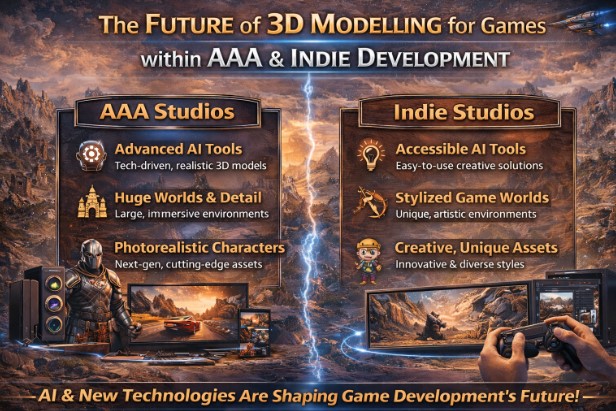
New hardware capabilities, strong game engines, and growing player expectations are pushing the game industry forward faster than ever. Quality is no longer about just realism but also performance, style, immersion, and uniformity across platforms.
At the very core of this evolution is 3D modeling for games, constantly adapting to the shifting priorities of both AAA and independent development. While large studios may work in very different ways from small teams, each is impacted by the future of modeling in different, meaningful ways.
It allows the studios to prepare for the challenges and opportunities that lie ahead by grasping where this discipline is going.
Increased Emphasis On Performance-aware Modeling
Performance will remain a top priority as more and more games target an increasing number of platforms from the start. Smooth frame rates on any device, with any hardware setup, raise demands in terms of asset efficiency.
Future modeling workflows will:
- Prioritize optimized geometry from the earliest stages.
- Integrate performance testing right at asset creation.
- Reduce reliance on late-stage optimization.
Studios considering performance as a design constraint rather than a technical fix will have an edge over others.
Increased Use of Procedural and Modular Approaches
Procedural tools and modular design are becoming increasingly prevalent at all scales of studios; these enable teams to efficiently create large volumes of content without loss of consistency.
Procedural workflows enable:
- Faster creation of environments
- Scalable Content for Open Worlds
- Reduced manual repetition
This means creating ambitious worlds on limited resources for indie teams, while for AAA studios, it means managing massive asset libraries more efficiently.
Assets Designed for Modern Lighting Systems
Improved interaction between geometry and animation.
It benefits realistic and stylized games alike since it will enhance believability without increasing the complexity of the game mechanisms.
Closer Integration Between Art and Engine
Modeling practices increasingly take note of and are influenced by the specific requirements set forth by engines. Artists no longer model, then consider scale, collisions, shaders, and performance constraints as an extra step in integrating their work into an engine; instead, such considerations are integrated directly into modeling.
This tighter integration leads to:
- Fewer import and adjustment issues
- Faster iteration cycles
- More predictable visual results
In productions of games, 3D modeling is becoming more and more intertwined with technical and design teams rather than an isolated entity.
AI and Automation as Supporting Tools
Automation and AI-assisted tools have started to affect modeling workflows. Instead of replacing artists, such tools support them in repetitive or heavy tasks.
Future uses could include:
- Faster Base Mesh Generation
- Automated Optimization Suggestions
- Geometry with enhanced error detection
Evolving Expectations of Asset Longevity
The games are living beyond their initial releases through updates, expansions, and live content. Assets need to be created with considerations for long-term use.
Future-ready assets will:
- It would be easier to modify and upgrade
- Keep consistency between updates
- Scale with new platforms & engine versions
Studios that plan for asset longevity minimize technical debt and future production costs.
Outsourcing as a Strategic Standard
It helps studios scale up their production, maintain quality standards, and adapt to the changing needs of a project without permanently expanding by outsourcing their work to a professional 3D visualization company. The said model is particularly valuable as projects are increasingly complex and timelines are more demanding.
The Indie Advantage in Creative Experimentation
While big AAA studios push the technical boundary, indies more often drive creative experimentation. Future modeling trends will definitely keep this balance in mind.
Indie teams most probably will:
- Try out unconventional styles.
- Use creative, simplified geometry.
- Strong focus on visual identity over realism.
These innovations will continue to trickle into the broader industry, as tools become more accessible.
Greater Player Expectations Across All Budgets
The developers could no longer build games on the basis of their budget size. Indie titles should be polished, and AAA ones should run seamlessly.
This raises the baseline for quality modeling across the industry like:
- Poor optimization is less tolerated.
- Visual inconsistencies are noticed quickly.
- Performance issues directly impact reviews.
- Future success implies consistency in meeting these expectations.
Continuous Learning and Adaptation
This rapid technological change means modeling cannot remain static. Artists and studios are continuously pressed to keep pace with changes in tools, engines, and workflows.
Studios should invest in:
- Skill Development
- Pipeline refinement
- Cross-team collaboration
Conclusion
Efficiency, scalability, and tighter integration with real-time performance requirements are what will define the future of 3D modeling for games. Even while cleaner workflows, smarter optimizations, and flexible pipelines continue to benefit both AAA and independent studios, they will differ in scale and resources. As these tools continue to evolve and as player expectations grow, so too will studios thoughtfully adapt their modeling practices to deliver stronger visuals, smoother gameplay, and more sustainable development processes.
