
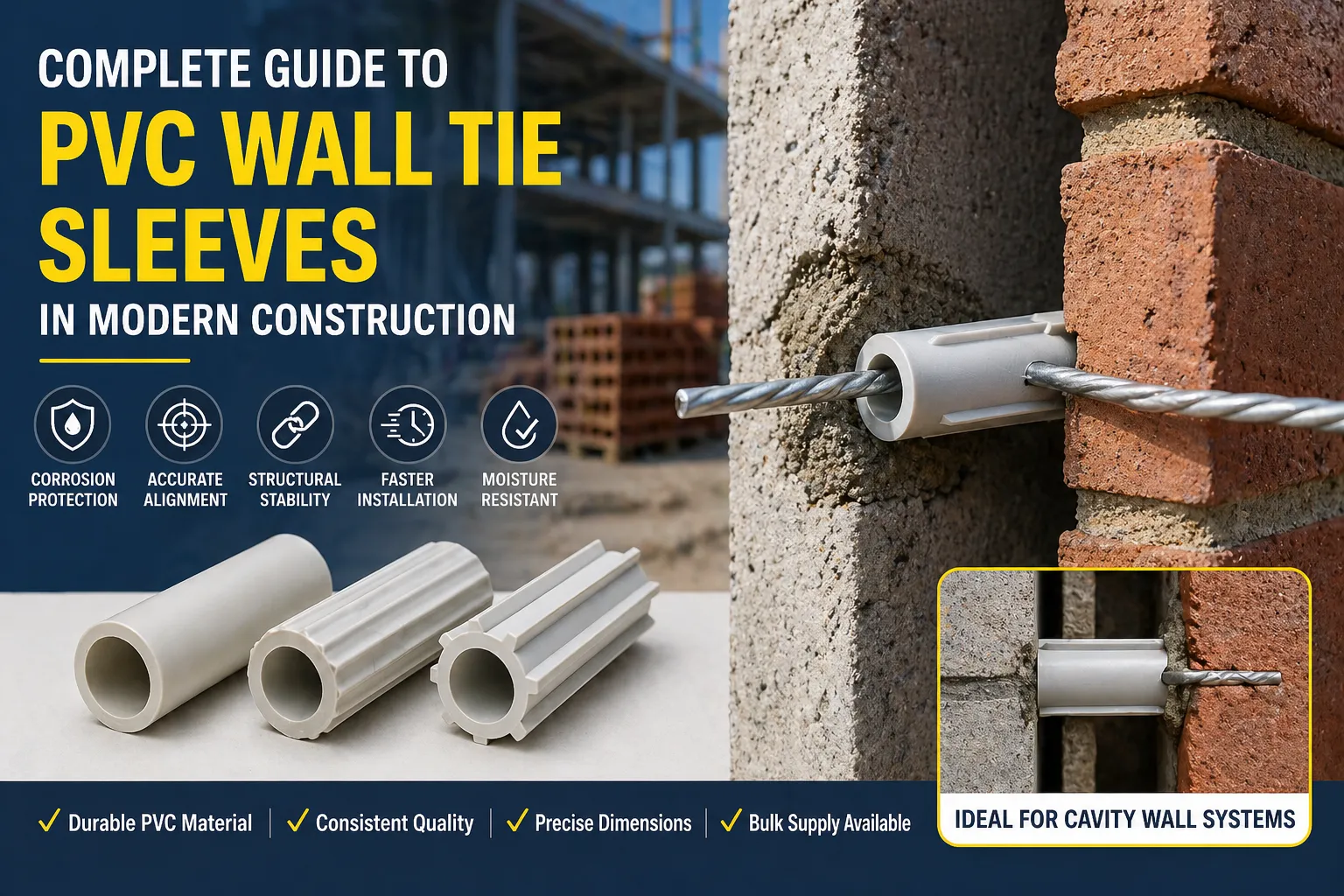
On most construction sites, problems do not start with big structural elements. They start with small components that are ignored. Wall ties are one of them. And more importantly, the sleeves that protect and align them.
As a PVC wall tie sleeve manufacturer in India, we have seen how minor variations in sleeve quality create finishing cracks, alignment errors, and unnecessary repair work. In modern projects, PVC wall tie sleeves are not optional accessories. They are practical site solutions that reduce labour issues and improve structural consistency.
If you are sourcing for residential towers, commercial buildings, or infrastructure projects, this guide will help you understand what works and what usually fails.
What Are PVC Wall Tie Sleeves?
PVC wall tie sleeves are protective plastic coverings used around wall ties during construction. They:
- Maintain alignment
- Prevent mortar blockage
- Allow controlled movement
- Protect metal ties from moisture
In cavity wall systems, a PVC cavity wall tie sleeve ensures proper spacing between internal and external walls.
Short answer:
A PVC sleeve for wall ties improves structural alignment and prevents corrosion and finishing damage.
Why Modern Construction Uses PVC Wall Tie Sleeves
Twenty years ago, some contractors ignored sleeves completely. Today, that approach rarely works.
Modern projects demand:
- Better structural precision
- Faster installation
- Lower maintenance
- Improved moisture control
That is why plastic wall tie sleeves have become standard in many building systems.
Many contractors now focus on PVC wall tie sleeves for consistent casting to reduce alignment and finishing issues on site.
In my experience, sites that skip sleeves often face small but repeated correction work. Over time, those corrections cost more than the sleeves themselves.
How PVC Wall Tie Sleeves Work
A construction wall tie sleeve is installed over the metal wall tie before embedding it into mortar or concrete.
The sleeve performs three key roles:
- Keeps mortar from bonding tightly around the tie
- Allows slight structural movement
- Reduces direct moisture contact
An extruded PVC wall sleeve is typically designed with a smooth internal bore and defined wall thickness for uniform casting.
Applications in Modern Construction
PVC wall tie sleeves are commonly used in:
- Residential apartment buildings
- Commercial complexes
- Industrial sheds
- Boundary walls
- Precast panel systems
In cavity wall systems, a PVC cavity wall tie sleeve helps maintain correct spacing and prevents mortar bridging.
For high-rise projects, alignment accuracy becomes even more critical. Small deviations multiply over height.
Key Benefits of PVC Wall Tie Sleeves
1. Improved Structural Alignment
A properly designed PVC sleeve for wall ties ensures straight installation.
Without sleeves, ties sometimes shift during casting. This leads to uneven wall finishes.
2. Moisture Protection
PVC acts as a barrier between mortar and steel. This reduces corrosion risk in humid conditions.
3. Reduced Finishing Cracks
When metal expands or contracts, the sleeve allows slight movement. This reduces surface cracks.
4. Faster Installation
Sleeves simplify positioning and reduce rework. Labour teams appreciate components that make their job easier.
Material and Manufacturing Considerations
When choosing a PVC wall tie sleeve manufacturer, check:
- PVC grade quality
- Dimensional accuracy
- Wall thickness consistency
- UV stability if exposed
- Batch consistency
An inconsistent extrusion process leads to loose-fitting sleeves. Loose sleeves cause misalignment.
In our operations at M3 Extrusion, strict dimensional control reduces site complaints and repeat casting adjustments.
What Usually Works on Site
From real-site experience:
- Sleeves with slightly textured outer surfaces grip better in mortar.
- Medium wall thickness performs better than ultra-thin designs.
- Standardised length simplifies labour training.
Simple designs often outperform complicated shapes.
What Often Fails
I have seen common failures such as:
- Thin sleeves cracking during installation
- Poor tolerance causing tight fitting on ties
- Uneven internal diameter restricting tie movement
One personal judgement: ultra low cost sleeves almost always create trouble later. Construction is not the place to cut corners on small structural accessories.
How to Select the Right PVC Wall Tie Sleeve
Here is a simple decision checklist.
Step 1: Confirm Tie Size Compatibility
Ensure internal diameter matches the wall tie specification.
Step 2: Check Sleeve Length
Length should align with cavity width and casting depth.
Step 3: Review PVC Quality
Request material specifications from the PVC wall tie sleeve manufacturer.
Step 4: Inspect Sample Before Bulk Order
Physically test:
- Fit on tie
- Resistance to bending
- Ease of installation
Step 5: Confirm Repeat Production Capability
Large projects require consistent supply over months. Batch variation creates visible differences in finishing.
Comparison: Sleeve vs No Sleeve
| Factor | Without Sleeve | With PVC Wall Tie Sleeve |
|---|---|---|
| Alignment | May shift | Stable |
| Corrosion risk | Higher | Reduced |
| Finishing cracks | More common | Lower |
| Rework frequency | Higher | Lower |
For modern building systems, sleeves are practical risk control tools.
Common Mistakes Buyers Make
- Selecting only on lowest price
- Ignoring dimensional tolerance
- Ordering without site testing
- Not confirming repeat extrusion consistency
- Overlooking environmental exposure conditions
Smart buyers treat building wall tie accessories as structural support elements, not optional add-ons.
Role in Sustainable Construction
PVC sleeves support durability. Longer-lasting structures mean fewer repairs and lower material waste.
In cavity systems, proper moisture separation improves insulation efficiency. That contributes to better energy performance over time.
While sleeves are small components, they play a role in overall building quality.
Final Thoughts from Experience
Construction success depends on small decisions made early.
PVC wall tie sleeves may look minor, but they prevent alignment errors, moisture exposure, and repeated finishing repairs.
In my experience, projects that invest in good-quality plastic wall tie sleeves face fewer structural complaints later. The cost difference per unit is small. The impact on quality is significant.
For modern construction standards, using reliable PVC wall tie sleeves is simply practical engineering.
FAQs
1. What is the main purpose of PVC wall tie sleeves?
PVC wall tie sleeves protect wall ties from direct mortar contact, maintain alignment, and allow slight structural movement. They reduce corrosion risk and minimise surface cracking in cavity wall systems.
2. Are PVC wall tie sleeves necessary in all buildings?
They are strongly recommended in cavity wall systems and large commercial projects. For small low load structures, they may not always be mandatory, but they still improve durability and alignment.
3. How do I choose the right PVC wall tie sleeve manufacturer?
Check material grade, dimensional accuracy, production consistency, and sample testing. A reliable manufacturer should provide technical specifications and maintain uniform extrusion quality across batches.
4. Can PVC wall tie sleeves reduce corrosion?
Yes. PVC acts as a barrier between metal wall ties and moisture within mortar. This reduces long-term corrosion risk and improves structural lifespan.
5. What problems occur if sleeves are not used?
Common issues include tie misalignment, mortar bonding that restricts movement, higher corrosion exposure, and finishing cracks. These problems often lead to additional repair work.
6. Are extruded PVC wall sleeves durable?
High-quality extruded PVC wall sleeves are durable and resistant to cracking. Proper wall thickness and consistent material quality ensure long-term performance in modern construction.
7. Do PVC wall tie sleeves affect installation speed?
Yes. They often improve installation efficiency because they simplify positioning and reduce correction work during casting. Labour teams generally prefer systems that reduce alignment errors.
